
Montana sourdough bread, submitted by Steve Murphy
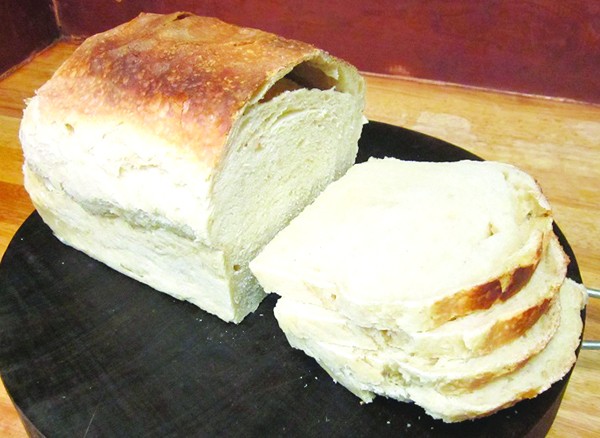
Montana sourdough bread loaf, partially sliced. Photo courtesy of Steve Murphy.
Montana sourdough bread, submitted by Steve Murphy
Kitchen items you will need:
- 1 quart wide mouth glass canning jar and lid. Punch a dozen or so holes in the lid with a nail so the starter can breath;
- Wooden spoon;
- Paper towels;
- Rubber band;
- Cotton cloth (T-shirt material works well);
- Wood or glass mixing bowl with tightly-fitting lid. I use a wok lid. Do not use a metal bowl as metal is an enemy to sourdough;
- Standard non-stick bread pan.
Ingredients:
- High Protein white unbleached flour with at least 12% protein. I use Wheat Montana Premium unbleached white flour (blue and white bag) from Three Forks MT (available at Albertsons, Walmart or their Three Forks store). Common bread flour has a much lower protein content and makes a poorer bread;
- Pure water (I use Spring Hill water). Tap water has chlorine which is an enemy to sourdough starter;
- White granular sugar;
- Sea Salt (Iodized salt is an enemy to sourdough);
- Active Dry Yeast (Original San Francisco sourdough bread uses the yeast method for a good rise. If yeast is not used, your rise will be weak);
- Whole fat sour cream (I use Tillamook);
- Cooking oil.
How to make sourdough starter (takes 5-6 days but lasts a lifetime):
1. Add 2 cups flour to jar. Dissolve 1 teaspoon sugar in 1 cup warm water and add to flour. Add more warm water or flour if necessary until you get a thick batter. Beat batter well. Let sit in a very warm place for 48 hours.
2. Beat the starter again and add 2 tablespoons flour and enough warm water to make a thick starter. Beat well. Let sit in a very warm place for 48 hours. Beat down well and refrigerate overnight.
3. Remove jar from refrigerator and place in a stock pot of hot water to activate. Beat down and throw out half the starter. Add 1 cup flour and enough water to make a thick starter. Beat well. Let jar sit 24 hours on your kitchen counter. If it is bubbling and active, the process is done and you have sourdough starter. Your should have 1/2 jar (2 cups) of sourdough starter. Note: At all times, keep a paper towel tent over the jar lid held with a rubber band. There are sometimes very small black gnats in our environment that are very attracted to starter and the paper towel tent will keep them out. Refrigerate until ready to make bread.
4. Starter Maintenance Tips: Never clean the inside of your starter jar or you will have to start over. Clean up outside from overflows only. Change paper towel tent after each use. If your starter fails to become active, add 1/4 cup of this inactive starter and start over as above in Step 1. Always refrigerate your starter until the day you are going to make bread. Remember, always take out half, put back half when making bread in Step 1 below. Never let yeast or sour cream get in your starter jar (mistakenly returning half from Step 2), it will turn bad.
To make one loaf of sourdough bread:
Take the sourdough starter out of the refrigerator and place in the bowl with hot water until it becomes active. Take out 1/2 of the starter and put in your mixing bowl. Dissolve 1 teaspoon sugar in 1 cup warm water. Add this to the flour and beat 50 times with a wooden spoon until thick. Return enough starter to make a half a jar of starter and beat well and let sit 24 hours on kitchen counter. Refrigerate starter jar with paper towel tent over the lid. Next, scrap bowl sides down, clean edges with paper towels, cover and let sit 24 hours in warm place covered with a warm well-dampened cloth between the bowl and the tight lid.
Dissolve 1 teaspoon sugar and 1/2 teaspoon yeast in 1/4 cup warm water until it bubbles and becomes active. Add to dough. Sprinkle 1 teaspoon salt (if desired) over dough. Add 1/4 cup whole sour cream. Beat well until blended and smooth. Work the liquids completely into the dough. Add enough flour so the dough is slightly sticky and can be folded into a ball. Roll dough out onto a floured surface and knead until you have a very smooth and elastic ball. Clean your bowl. Coat bowl with cooking oil and roll the dough ball inside the bowl top side down until top of dough ball is coated with oil. Turn top side up. Cover dough with warm well-dampened cloth and cover the bowl with your tight lid. Let sit in a warm place for 24 hours (for extra sour bread, 36 hours).
Turn the dough ball out onto a floured surface and knead until very smooth and elastic. Using too much flour will result in a dry bread-keep it as moist as possible but still kneadable. Knead the dough longwise by folding, flatten, and fold ends under. Turn the dough over and pinch all seams closed. Place in shortening-coated standard bread pan smooth side up. You should have a little more than a half-filled pan. Cover with a warm wet cloth and let proof (rise) until dough is just over the top of the pan. Spray top of loaf with water. For extra crusty loaf top, place a pan with 1/4” water in the bottom of the oven before baking. You can cut lines in the top before baking for a more rustic loaf but I find it hard to run through my power slicer. Bake in preheated oven at 400F for 45 minutes. Let cool before slicing.
Note: For two or three loaves, double or triple ingredients and increase the size of your jar to 1/2 gallon so you are always taking out half and putting half back. You always need one cup of starter for each loaf.
This may seem a long and complicated recipe, but once you have done it a couple times, it is quick and easy. It takes no more that 15 minutes work all the way through to make one loaf. Enjoy.
Category:

