
Mountain of Memories: The pleasures of the Mount Haggin Wildlife Management Area, Montana’s largest WMA, across years and seasons
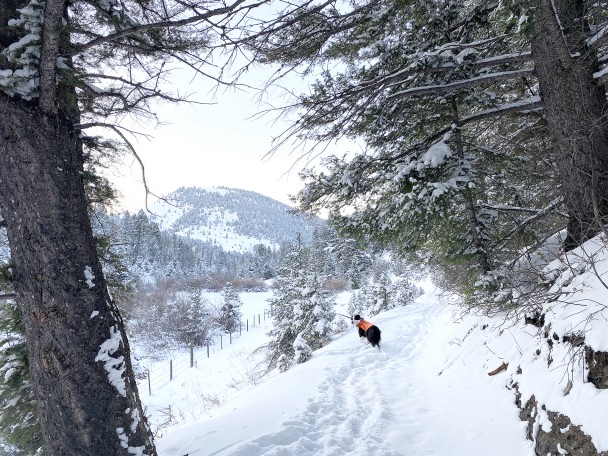
"Butch Cassidy," border collie and hunting and hiking parter, looks back up the trail. Photo courtesy of Nicole Qualtieri.
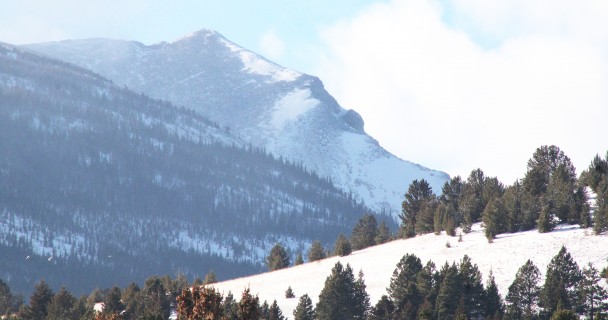
Mount Haggin peeks out from the foothills above Anaconda. "When the WMA shuts down each December, I look up at the slopes above Anaconda and wonder, 'What’s happening up there? What’s it like right now?' Every place I’ve lived, I’ve developed four-season familiarity with the public lands nearby. But I’m happy to let Mount Haggin WMA remain a winter mystery, knowing wildlife need that respite," Qualtieri writes in the November/December 2025 edition of Montana Outdoors – and in today's Anaconda Leader. Leader file photo.
Snow fell thick starting at dawn on the last day of the rifle hunting season. With an unfilled B tag for a cow elk and shooting hours wearing thin, I shook myself from my office chair, piled on layers, threw my rifle over my shoulder, and headed out the door.
Driving toward Mount Haggin Wildlife Management Area, my thoughts wandered back to September when I toted my bow through a different part of the WMA on opening weekend of the archery season. I’d gotten brave enough to try my beginner bugles and was surprised to get an immediate answer. It rang back as withering and questionable as my own call.
I soon spotted the pair of archery hunters just before they spotted me, and grinned.
“We thought it was probably another hunter,” one said, smiling back. We headed different ways after much-needed wishes of luck. I climbed to a ridgeline where I sat and watched a small herd of mule deer does and fawns graze until light waned into darkness. No actual elk or real bugles, but a perfect day with miles and elevation under foot.
That day was almost too warm for hunting, and the elk were likely deep in the thick timber shading much of Mount Haggin WMA, which spans more than 60,000 acres. It isn’t an easy place to hunt, and cow elk are managed conservatively; they’re only huntable by the B tag I held. But that tag inspired a sense of discovery, and I lit out afoot, more excited to explore new country than pack out a cow solo. I walked miles of hilly landscape, only occasionally on trails, and without a serious agenda, pushing aside more earnest hunting tactics in favor of exploration.
That fall, a hard-hunting friend told me he gets annoyed with hunters who think they’re going to walk themselves into deer or elk. I needed to be more strategic, he advised. I told him I got into hunting because I liked walking and was okay with odds stacked against me. Even preferred it.
You don’t get it, we both seemed to think at the same time. At this, we laughed and agreed to disagree, to hunt our own hunts. I filled other tags elsewhere, but this was more a chance to get to know a new larger landscape rather than whittling it down to the likeliest habitat.
Close by and quiet
Five years have since passed, and the hills of Mount Haggin WMA still beckon from my front porch in Anaconda, beyond fields of grass and sagebrush, small farms and ranches, to the pockets of dark timber on the foothills of the Anaconda-Pintler Wilderness. The WMA’s namesake mountain stands on the edge of those peaks, but I can’t see it from my humble home on 20 acres with a horse, a mule, three donkeys, two dogs, and a formerly feral barn cat that now lounges on the couch. It takes me just 20 minutes to reach the wildlife area. I can count on two hands the fellow hikers I’ve met there in the past five years. Hunters arrive in greater numbers come fall, but even then, they’re sparsely distributed.
Where I like to go, there aren’t massive panoramic payoffs. The trails are old logging roads, and most of the streams aren’t big enough to fish. But it’s close and provides solitude. I’ve learned where elk find water in unlikely places and where a particular grouse hangs each summer to raise her chicks. There’s a shallow knoll where I accidentally came within 10 yards of a cow moose and her red wobbly legged newborn. I was thankful my dogs were oblivious as the mother led her baby at a brisk trot down the path toward the trailhead. I waited an hour to walk the dogs back to the truck.
The lower elevations of the WMA are prime winter range that helped that cow moose and many before her produce the future of Mount Haggin’s moose population. From December 1 to May 15, the portion west of the Continental Divide is closed to human recreation, offering respite for moose as well as elk, pronghorn, mule deer, whitetails, black bears, and the occasional grizzly, lynx, and wolverine. Vanna Boccadori, FWP’s Butte-area wildlife biologist, says 400 to 600 elk winter on the wildlife area every year. They’re joined by 100 to 200 mule deer, and a few dozen moose.
On one spring hike, the unmistakable rhythm of Who cooks for you? Who cooks for you all? echoed through the Mount Haggin woods, the first barred owl I’d heard in Montana. I called back, hoping it might get curious enough for a look. We talked back and forth a few times, but I never saw it. With late spring thunder rumbling in the near distance, I headed for the truck, my dogs bounding with sticks in their mouths through the green-up.
When the WMA shuts down each December, I look up at the slopes above Anaconda and wonder, What’s happening up there? What’s it like right now? Every place I’ve lived, I’ve developed four-season familiarity with the public lands nearby. But I’m happy to let Mount Haggin WMA remain a winter mystery, knowing wildlife need that respite.
By the time the area opens to the public in mid-May, I drive in, my dogs whining with excitement as we approach familiar trailheads. Soon I’m following a path noting patterns of scat, prints in the mud. I breathe it in.
Birth of an amazing place
The remains of history are easy to spot in the rocky mounds of tailings within the WMA, even if you don’t know much about the area’s span of human engagement. Before the 1800s, the area provided hunting grounds and gathering sites for the Kootenai, Pend d’Oreille, and Salish peoples, among others. The late 19th century ushered in a very new era—the reign of the copper barons. Mount Haggin was clear-cut to supply wood to fuel the Anaconda Mining Company’s smelters and home stoves in Butte and beyond. With the trees went the wildlife. By the early 1970s, the future of the mountain and surrounding lands looked grim.
A local homesteader and conservationist named Deanye Rousch had an idea. She convinced The Nature Conservancy (TNC) to buy a massive block of land the Anaconda Mining Company was selling. TNC purchased it, then resold it to FWP in 1976 to create the Mount Haggin WMA, protected in perpetuity as a place where wildlife take priority. Rousch is now approaching her ninth decade and still maintains her homestead nearby.
Boccadori oversees management of the WMA, helping coordinate volunteer habitat work projects and updating the public on Mount Haggin and the rest of the region she covers. Her community emails help me and others stay abreast of the latest wildlife news.
An assembly of conservation nonprofits also focuses its efforts on this stretch of habitat. The Rocky Mountain Elk Foundation, Anaconda Sportsmen, Skyline Sportsmen, George Grant Chapter of Trout Unlimited, Big Hole Watershed Committee, and others have helped add acreage to the WMA and recruit volunteers for restoration work. Boccadori gives special credit to Rousch and the rod and gun clubs, noting they’ve stood up for their hometown wildlife area with constant care, communal efforts, and commentary.
Restoration within the WMA and other habitat areas nearby continues, boosted by mitigation funding earmarked for restoring or replacing lands harmed by mine waste in the Clark Fork River basin.
Many places once heavily logged and mined are slowly recovering. “Mount Haggin is an amazing place,” Boccadori says. “Being the largest WMA in Montana and spanning the Continental Divide, it encompasses big game winter range, birthing and summer range, and the migratory pathways between these vital areas. I’m always humbled when I think that elk, deer, and pronghorn have likely been using it for millennia, passing down herd wisdom across thousands of generations. It’s an honor to help steward this landscape for a relative blink in time.”
Ironically, one of the biggest wildlife habitat challenges facing Boccadori is that parts of Mount Haggin have too many trees. Without logging and wildfires to maintain open areas, juniper, lodgepole, and Douglas fir are taking over sagebrush shrublands, grasslands, young aspen stands, and streamside areas that are vital for songbirds, small mammals, and game species. Since 2010, FWP has contracted with timber companies and firewood suppliers to selectively log small stands of aspen and conifers at Mount Haggin and several other western Montana WMAs. Thriving in the newly opened areas created by low-intensity timber harvest are grasses and wildflowers that deer and elk eat and songbirds use for ground nesting. Thinning also encourages new growth of shrubs like bitterbrush browsed by mule deer and moose. Removal of thick underbrush created by decades of fire suppression reduces the risk of catastrophic wildfire that can threaten surrounding communities.
That late November day I left my house to hunt still stands out as my favorite on Mount Haggin. As I quietly pulled my truck door shut, the thermometer stood at 10 degrees, the sky a deep blue daubed with high wispy horsetails. Cozy in synthetics and wool, I hiked uphill to sit, watch, and wait in a spot I knew that elk used. Mindful of the direction of the slight wind, I passed a few empty elk beds in the snow along a path thick with the morning’s prints.
Then as the golden hour before sunset took hold, a diamond dust of snow crystals sparkled down from snow-laden pines hovering above. A hoar frost tipped my eyelashes as my exhales crusted my hood and neck gaiter with ice.
I sat 45 minutes before the cold began to pierce my layers, prodding me to begin the trek back before shooting light ended.
In the snow next to a tall pine where a grouse had once surprised me, I found a perfect imprint of a small bird of prey. I leaned in to investigate: wings high, talons down, a clear impression of a beak. It didn’t appear the bird had come up with its intended prey. Like me, it had gone home empty handed. I hustled to get my blood flowing.
Back in the driver’s seat, the temperature read -8. That sharp drop accounted for the diamond dust I’d seen and the long time it took for my truck to warm up. As heat finally began to fill the vehicle, I sat and watched my surroundings in the fading light. Four mule deer crossed an opening high above, silhouetted against a snowy ridge, grazing for warmth.
I drove out of Mount Haggin with the cover of winter stark white behind me, counting the days until green-up and open gates.
Nicole Qualtieri is a writer and editor in Anaconda and is the editor-in-chief and founder of The Westrn. https://www.thewestrn.com.
Editor’s note: This article originally appeared in Montana Outdoors magazine, November/December 2025 edition, published on Nov. 1, 2025. It is being republished with permission. See the original publication online at https://issuu.com/montanaoutdoors/docs/montana_outdoors_november_decembe....
Montana Outdoors is published by Montana Fish, Wildlife & Parks. Learn more at: https://fwp.mt.gov/montana-outdoors.
Category:

