
Urban Wildlife Task Force gets feedback on issues ranging beyond the deer in town
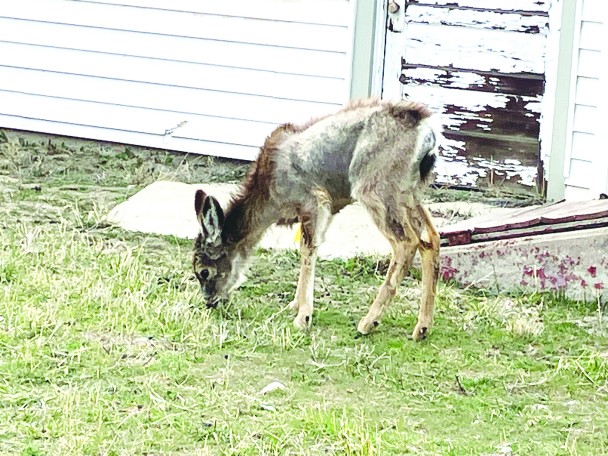
A malnourished young deer looks for food in a yard in Anaconda in a recent photo taken by and shared with permission from Kirstie Yeager, the Montana Fish, Wildlife & Parks wildlife biologist for the area.
Though the deer, and their poor health, are still the top concern
The recently-established Anaconda-Deer Lodge County Urban Wildlife Management Task Force met Wednesday night at the Metcalf Center to get direct feedback from the community on several issues affecting Anaconda. Commissioner Ed Beaudette, the task force's secretary, kicked off the meeting with board introductions and quickly turned the floor over to Fish, Wildlife, and Park Game Wardens Joe Kambic and Sarah Swingley and Brad Balis, FWP Bear Management Technician for the ADLC area.
“One thing that does kind of eat our lunch a little bit in town, I mean, we’re trying to do a job that requires us to be in a large area. And every year it seems to just keep bringing us back. Whether it’s sick deer, injured deer, deer with Christmas lights on their antlers,” Kambic said, explaining that the exorbitant amount of deer calls are preventing them from fulfilling their other obligations.
He explained that the large deer population has resulted in vehicle collisions, insurance reports, damage to property, and deer sickness, which he reported “isn’t a healthy population of deer,” and continued, “you can look at them, you can tell, they’re not getting the right nutrients. They’re not eating the things they’re supposed to eat.”
Swingley said that the main reason the deer are here is due to people feeding them, a topic that came up throughout the meeting. Before that, attention was turned to bear activity in the area. Balis stated that the increase in bear activity is very preventable, explaining that unsecured garbage, bird feeders, and other readily available food sources are primarily to blame. He also mentioned the increase in grizzly bear inhabitation in our area.
“Just for this ring alone, as far as confirmed grizzly bear reports, we’ve detected one on the east side of Deer Lodge, one on the west side of Deer Lodge, we had another confirmed report out of Garrison, Philipsburg, one down by Wise River, and one over by Boulder,” he said. “So, we’re definitely seeing more and more bears around this way.”
They addressed mountain lions as well and expressed that people tend to catastrophize after seeing one, but it isn’t a main concern. However, they said that the deer population can certainly be attractive and they feel that controlling the town’s deer population could directly reduce that risk.
An audience member asked if it would be possible to tranquilize the deer and transport them out of town. Swingley replied that it would be expensive, but more importantly, the deer are sickly, domesticated, and unlikely to survive in the wild, adding that if ADLC choose to do a cull it would be an ongoing effort.
“It’s not like a one-and-done type of situation. Other towns do it every year, every couple years, they set up the plan that they want to go with and it works to bring the numbers down to a tolerable level, from our experience,” she said.
Next, the topic of issuing citations to people feeding the deer came to the forefront. Kambic explained that the majority of people he has confronted genuinely feel that they’re helping the deer by feeding them and after an explanation most people are willing to stop doing it. That being said, he will attempt to communicate before issuing citations whenever possible.
“So, how do we get the bigger picture out there and say, we know you truly want to do what’s right for them, but you’re not. And bad things are happening to them. Now, if we have to go back and talk to them several times we’re going to give them a ticket. But man, we really don’t want to go that route if we don’t have to,” he said.
An audience member asked who would be responsible for culling if that’s the decision they come to. Swingley responded, “So yes, we have set up these things across the state in numerous other places, but generally the people doing the culling are not FWP. They’re the city people or they hire out contractors.”
The conversation circled back around to what seems to be the major contributor to the overabundant deer population: Locals feeding the wildlife.
Balis explained, “whether it be feeding deer or feeding bears, whatever, we have found that it really does take the entire community trying to address it for it to actually work,” he said, stressing the importance of communicating with your neighbors.
Another important issue of discussion was what would happen to the meat if the deer were culled.
“If that kind of thing takes place, the primary goal is to have the deer processed and given to a food bank,” Beaudette said, adding that he contacted the local food bank.
“They said 'hey we’d like to do that, but we don’t have enough freezer space and right now we don’t have anybody who can process.' So I asked him to try to contact people and see if they would volunteer,” he said.
Kambic responded, “So, one of the things that we could potentially look at is talking to the prison because I know that they had to shut down [its meat processing] at one time because they didn’t have enough meat to cut. That could be an option.”
Beaudette explained that he has been working with Balis, Commissioner Mike Beausoleil, and a handful of non-governmental agencies that provide bear-proof garbage cans and focus on Washoe Park.
“Through the summer there’s so much garbage that can be attracted and a number of people will see bears just walking through there knocking over garbage cans. So that’s one of the things that we’re going to try to do, since that’s one of their primary memory sources for them. And of course, the creek running through is a natural highway so that’s what they’re looking for. So, that’s what we are going to try to do, is work on that particular problem, also, along with the education to not have people putting out attractants on their own property,” he stated.
Kambic added, “We have to be responsible to the wildlife and that’s why we’re here. I’m a lifelong Montanan myself, I’ve never left, I care deeply for the wildlife, that’s why I do the job that I do is to protect them and make sure they’re around for generations.”
To submit questions or comments visit adlc.us/920/Urban-Wildlife-Management-Task-Force-Board. Minutes from the meeting are also available on the website.
Category:

