
So who was Daly really? Historian delves into the life of Anaconda's enigmatic founding father
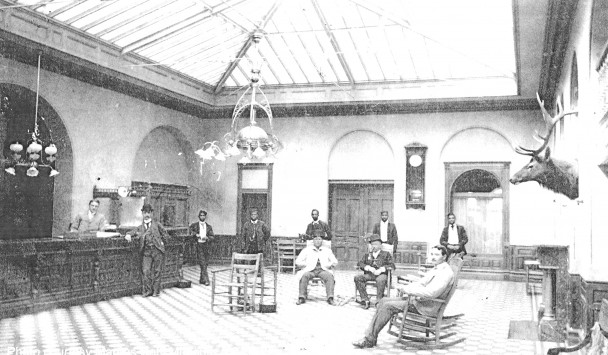
Pictured in the Montana Hotel office looking from the front entrance in Anaconda on Sept. 6, 1889 is Marcus Daly, seated second from right, where he is joined by a Mr. Law, superintendent of the Montana Union. Fittingly the former Montana Hotel, now the Historic Montana, will be the site of historian Brenda Wahler's book launch event for "Marcus Daly's Montana Empires: Copper Mining, Racehorses and Politics" on Friday, March 6 at 6 p.m. Photo courtesy of Copper Village Museum and Art Center.
Following up on our initial article from the Friday, Feb. 28 edition on the release of "Marcus Daly's Montana Empires" and the book's upcoming launch event on Friday, March 6 at 6 p.m. at the Historic Montana (formerly the Montana Hotel), the Anaconda Leader sat down for a wide-ranging interview with the book's author, historian Brenda Wahler, touching on Daly's three empires covered in her book: copper mining, racehorses and politics.
Daly's papers famously (or infamously) were burned upon his death per his orders, making research beyond the narratives that have already been told of the Copper King a challenge, but the horse-racing aspect of his life would prove to be of great help to Wahler's research into his other empires. That's because as part of her research she created a spreadsheet of everywhere Daly was known to have been by date, and from there she started correlating where Daly was when important things in his life and business interests were happening.
One example of that was one of the few races where Daly was able to see one of his horses run – and win; Ogden at the Futurity Stakes in New York on Aug. 15, 1896. Three days earlier, Daly had been at Madison Square Garden to hear William Jennings Bryan accept the Democratic Party nomination for president. Daly would remain in New York for another week after Ogden's race, and on Aug. 22, 1896 it was announced that the Anaconda Copper Mining Company had been admitted to the Boston Stock Exchange, which would mark the beginning of the formation of Amalgamated Copper, one of the largest trusts in the world at the time.
And there's another intriguing facet to that intersection of politics and horse racing: Daly's winnings at the track that day.
"Daly comes to down when Bryan's running for president. He wins about $60,000 at the track," Wahler said. "Then all of a sudden Bryan has about $60,000 donated to his campaign. I don’t know, correlation?"
It wasn't so much that Daly was betting on his horses as a form of campaign finance, but rather an example of what Wahler – whose initial research on the Copper King centered around horse racing – had been looking for: what he valued.
"What I discovered is – I’ve always been interested in that world of how did people come by the large fortune they spent on horses. What you discover is people who had a passion for horses that they – why were they blowing all their money on horses? Well everyone has a thing they have a passion for. So how did they make that money?" Wahler said. "Tying into the horse racing and linking that back to the network of high finance – we see [Daly at the] Futurity Stakes in 1896 was responsible for the reorganization of the Anaconda Company. That was one of the things that blew my socks off."
Stressing that "nobody makes money on horses – if you want to have a small fortune with horse racing, start with a large one," Wahler said that with horse racing, "Daly had a genuine passion for horses."
"He had an eye for horses from the day he was born. But you also had to make a living," she said. "I think Daly was sentimental about Tammany. … I think he was trying to emulate [James Ben Ali] Haggin at first, but he was trying to exceed Haggin. If Daly had lived for another decade we’d still be talking about Daly’s farm like we do with all the famous stables today. He died before it came to fruition. ... If you’re into horse breeding, what you can see with Daly is he kept improving his stock. He was constantly upgrading. He was in it for the long haul and I think with Haggin retiring, Daly was sort of stepping up into the shoes of the big western horse breeder. I think that Daly’s motive was to be – Haggin wanted to be the biggest dog on the block, while Daly wanted everything he did to be the best. You look at the Anaconda Standard, the money he poured into it to make it a regional newspaper."
A regional newspaper that was instrumental not just in Daly's business interests but also his political ones, which ties back to Daly's support of Bryan – who long before his "Scopes Monkey Trial" days was a forerunner of economic populism via the "Free Silver" movement that sought to overturn the gold standard and restore silver as legal tender in the United States. An interesting facet of the Copper King's political life, considering his status as among the wealthiest people of his time, though both Daly and bitter rival William Andrews Clark both were Bryan supporters likely in part due to their mining interests.
Again, tying back to that spreadsheet – though this time not pertaining to horse racing – Wahler found that when Bryan came to Montana in 1897 after losing the first time around the previous year, he had a major campaign rally in Butte to prepare for the election of 1900, but he also had one in Anaconda.
"I knew about the poem 'When Bryan Came to Butte,' and I was doing some research on the guest book at the Daly Mansion – I cite that quite a bit in my book – and I was going through it they year before last and they asked me to do a talk there. They have done a table where they’ve transcribed the whole thing. I noted how often Phoebe Hearst had been there, Haggin visiting, and they asked me to do a talk about famous people who had been at the mansion and as I go through and see William Jennings Bryan and think 'what the heck?' He came there with his whole family," Wahler said. "I correlated that with his visit to Butte, [and from that] it turns out Daly appears to be his single largest campaign contributor."
Even more surprisingly, she also found that not only had Daly supported Bryan's campaign financially, he also supported him publicly – from the very steps of his beloved Montana Hotel.
"Daly didn't give many speeches in his day, but he did give one with Bryan at the Montana Hotel – and it was straight out of the populist playbook. It reads like something you'd read today," Wahler said. "He was living in a really revolutionary period. We have the Montana of the mountain men, the early settlers, the early miners, then Daly arrives with this new technology, the railroad, electricity, the steam engine. That whole age of industrialization. He’s riding the wave. Sometimes he wipes out. Sometimes he makes it all the way through. It was a hard story to tell because just when you think you have a theme it takes a hard turn. You have a financial crash, the Panic of 1893, he gets the Works going and someone burns it down. A theme I play with in the book is the Trickster of Irish mythology, the Pooka. Sometimes things don’t work out, sometimes they didn't."
While Wahler's research into Daly's politics, his business interests, his racehorses, his friendships (particularly Haggin) and his rivalries and enemies (particularly Clark, but others of note) bore much fruit, one aspect that she would have liked to have been able to explore further was "the whole world of high finance" that he was navigating.
"Especially the stuff going on around 1895," she said. "We don't know why ultimately he ended up with Amalgamated ... even in 1891 where I look at those articles of incorporation, the syndicate that's trying to corner the market, playing chicken in Europe, that was Haggin playing hard ball, and him saying 'Marcus can you update the smelter one more time?' You had copper dropping – they were trying to get it down as far as they could while still making a profit. So I think the way international finance came to Anaconda – and we spend all this time talking about the West and how remote it is. But copper and the ability to refine it in Anaconda was shaking up the financial structure of the world. It's not a coincidence that the same people running Standard Oil are running Anaconda Copper. You think about – when I taught history at Helena College, it's amazing how people got things done, but no internet, no doomscrolling. The railroad changed everything. The railroad is then what the internet is now. Between the rail and telegraph and the birth of electricity, Daly lands on a mountain of copper right as they invented the light bulb. Right place, right time. Montana was on the cutting edge of technology. Talk about Silicon Valley, let’s talk about the Summit Valley in Butte and the resource that changed the world, electricity and copper."
So when all is said and done, who was Marcus Daly exactly? In a way he still remains an enigma – and perhaps the "Pooka" wouldn't have it any other way.
"In some ways he was making it up as he went. You can't say he was born in Ireland the son of a miner, he was born the son of a tenant farmer. How he found himself in Montana – that's where the Pooka comes in. Life is full of twists and turns. I really do think we try to ascribe to historic figures some kind of grand master plan when they're making it up as much as we do," Wahler said. "What I tried to do is, I could never decide whether he was a scoundrel, was he a hero or whatever. I think that with Daly being here – as his life got more complicated, he wasn’t here as much as he used to be. But if you look at the overall pattern, he had come to Montana at 1876 and established himself here before he ever met Haggin. Haggin was a lot older than he was, I won’t go so far as to say it was father-son relationship maybe uncle-nephew relationship. I think they genuinely liked each other. There’s so much material that I couldn’t get in that I wanted to get in. ... [But] there's gold in the foothills. I really encourage people to look for what I'm citing for the information. I tried to leave bread crumbs for people looking in the future."
There won't be much longer to wait for the "Marcus Daly's Montana Empires" launch event, which will be on Friday, March 6 at 6 p.m. at the Tammany Ballroom of the Historic Montana, 200 Main St. in Anaconda. The event is free to attend, is open to the public and light refreshments will be available.
"Marcus Daly's Montana Empires" is published by The History Press, an imprint of Arcadia Publishing. For more information, see https://www.arcadiapublishing.com/products/marcus-dalys-montana-empires-....
Category:

