
Remembering John McNay: A tribute to the late Anaconda Leader editor
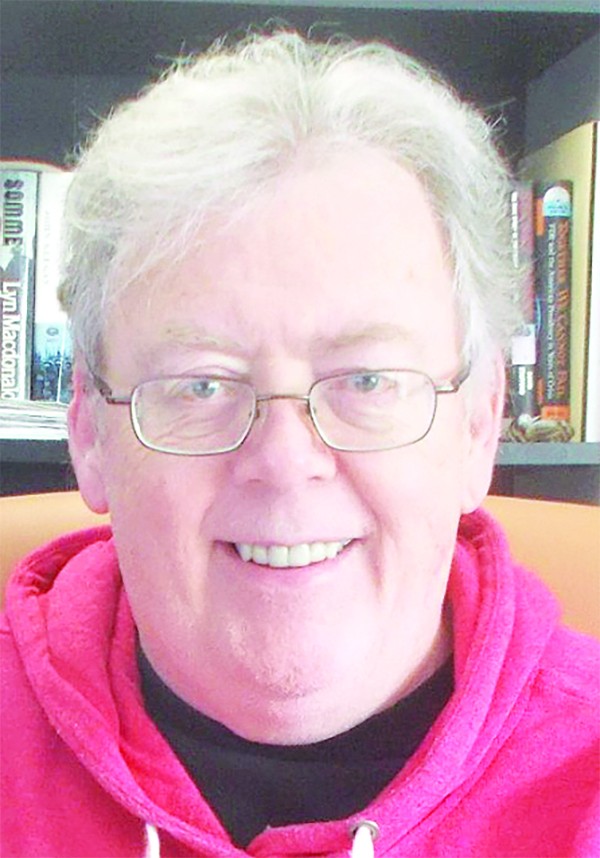
The late Dr. John McNay is pictured here. Photo courtesy of Ed Kemmick.
Editor’s Note: This article first appeared in The Billings Times.
It’s been a strange, sad, humbling, beautiful experience to read all the tributes to my friend John McNay, a native of Anaconda who died in Cincinnati on Oct. 27.
Facebook was overflowing with praise for McNay (we rarely called him by his first name) from current and former colleagues and students at the University of Cincinnati-Blue Ash, where he’d been a history professor for more than 20 years. Those tributes painted a picture of a rare teacher—a great lecturer but a better listener, highly intelligent and knowledgeable without being overbearing, forever thrilled by being paid to inspire in others a love of learning.
The photos accompanying the tributes told the rest of the story. In so many of them he is gathered around a table with smiling friends, eating good food, drinking good beer and engaging in lively conversation, Socrates in a polo shirt.
All of McNay’s professional accomplishments—his teaching, his books, his European battlefield tours, his work as a union advocate and defender of academic freedom—came long after the years I knew him best. But the person he would become was already apparent.
Professor McNay? I can close my eyes and see him, sitting across the table from me in a booth at the 4Bs Café on Broadway in Missoula in the late ’70s. It would be sometime after the bars closed at 2 in the morning and McNay would invariably be sitting in front of a platter of steak and eggs, far from sober but still lucid.
He might be talking about ancient history or local politics, labor strife or even the Grizzlies, though aware of my unfathomable lack of interest in sports. I can see him slowly gesturing with his left hand, as if rolling a piece of chalk in his cupped palm. Once, when our server mistakenly brought us an extra order of steak and eggs, McNay insisted on her sitting down to join us. She was soon as enthralled as I.
I met McNay at the University of Montana School of Journalism. I don’t remember exactly when or how I made his acquaintance, but we were soon fast friends. With fellow journalism pal Mike Dennison, McNay and I shot so much pool that’s it’s a wonder I was the only one of the trio who failed to earn a degree.
McNay and I worked together at the student newspaper, the Montana Kaimin, and later were friendly competitors when I was a reporter in the Anaconda Bureau of the Montana Standard and he was editor of the twice-weekly Anaconda Leader.
Because McNay was a native of Anaconda, I had the pleasure of meeting many of his old friends and relatives, notably his cousin, Red Menahan, a longtime member of the Montana House and one of the best storytellers I ever met. Red was the person McNay most resembled, physically and in temperament.
I was lucky enough to have been in Anaconda for its hundredth birthday on June 25, 1983, which happened to be my 28th birthday. McNay and I started celebrating Anaconda’s centennial well before noon, and despite my best intentions I finally surrendered to sleep about 11 p.m., an hour shy of McNay’s 26th birthday. He was never more disappointed in me.
It’s difficult to choose only one anecdote illustrating McNay’s appallingly messy housekeeping, but I suppose this one will do: at an apartment he rented in Anaconda, his electrical outlets stopped working one by one, and he was too embarrassed by the heaps of dirty clothes and the stacks of crusty dishes to call his landlord. I went over one night to find McNay in the kitchen, reading a book by the light of his television, plugged in to the last working outlet.
The real significance of McNay’s Smelter City ties, though, was that he came from a long line of union members, including several labor leaders. Among them was his great-aunt, Kathleen McGuire, a founding member of the Montana Federation of Teachers. Nobody who grew up in Anaconda and Butte in those days had to be told about the dangers of unfettered industry, or the power of communal action.
McNay didn’t stay in journalism long. He went back to school and earned a master’s degree and a doctorate in history. He would go on to be president of the University of Cincinnati chapter of the American Association of University Professors and president of the Ohio Conference of the AAUP. In 2011, he played a key role in a ballot initiative that overturned an Ohio law that would have neutered public employee unions.
He later wrote a book about that fight, “Collective Bargaining and the Battle of Ohio.” It was one of those books that is important as a historical document but destined to sell few copies, resulting in a very high sticker price, something like $75. “Just forget about it, Eddie boy,” he said to this non-union newspaper reporter. “I don’t expect you to read this one.”
In 2014, on the strength of that book, McNay returned to Montana to speak at the 58th annual convention of the Montana AFL-CIO at Fairmont Hot Springs, just down the road from Anaconda. I know it was one of the proudest moments of his life.
But death has a way of turning our attention to what really matters. I can’t stop thinking about what a fine human being McNay was. He was generous in his relationships with colleagues, students and friends, generous in a completely natural way, with no thought of personal advantage or reward.
Although he dealt with health problems for most of his life, he rarely complained, and he had a knack for making everyone in his orbit a little happier. It’s hard to picture his face without seeing his smile.
There was always a lot of laughter when McNay was around, but he somehow laughed without making a sound, with his head thrown back, his mouth wide open and his whole body shaking. Which of course just made everyone else laugh all the louder.
Many, many people are going to miss McNay’s deep commitment to justice, miss his efforts to make this world a better place. Me too. But I’m really going to miss not hearing that laugh.
Category:

