
Officer who was in charge of the gun battery that fired the last shot of World War I was from Anaconda
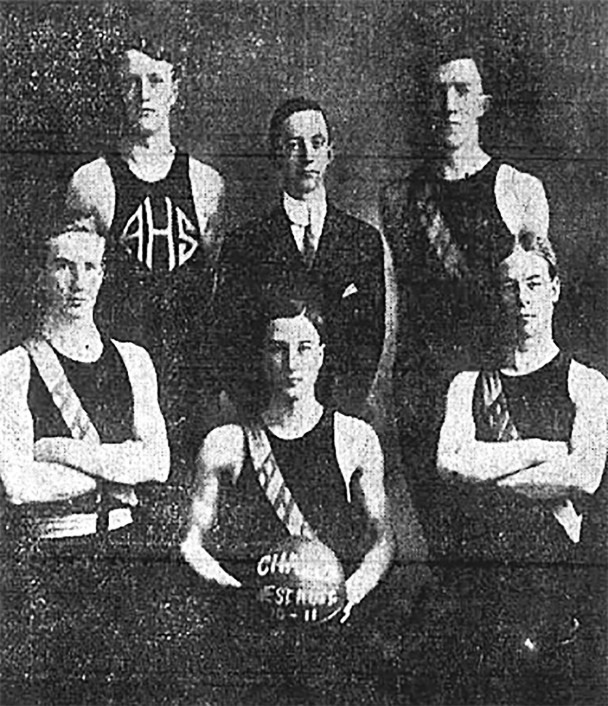
Guy Burnett, the officer in command of the gun battery that fired the final shot in World War I, is pictured top right in this Anaconda High School basketball team photo from the March 12, 1911 Anaconda Standard, the only photo of Burnett currently known to exist.
At the eleventh hour of the eleventh day of the eleventh month, the guns fell silent on the Western Front. It's a saying that's been passed down for generations, as the First World War came to an end at 11 a.m. on Nov. 11, 1918. And at the center of that world-historically important moment was a soldier from Anaconda who was the officer in charge of the gun battery that fired the last shot of the war.
His name was Guy Burnett, sergeant first class in charge of Battery E of the 11th Field Artillery Regiment, and he was a newspaperman who got his start with the Anaconda Standard.
It's a story that ought not to have been forgotten. Newspapers at the time of his death in 1940 describe him as a well-known former resident, born to a pioneer family in Anaconda in 1893, who later became commander of the American Legion in Anaconda, though unfortunately no photo of him is displayed at the legion hall amongst the other past commanders. Indeed as of this writing, no photo of him is known to exist other than the one of his Anaconda High School basketball team in 1911, a team that took second place at the "state interscholastic championship" as it was known at the time. Perhaps had he not moved to Oregon where he worked for the Oregonian until his death at age 47, leaving behind a wife and two sons, he might be better remembered today.
Yet his story has resurfaced, thanks to the research of Kathy Ilene Lunde, who provided the Anaconda Leader with copies of Burnett's obituaries from the Anaconda Standard, the Butte Miner and the Butte Daily Post, as well as other clippings relating to his life, including a letter he wrote back home from the front in September of 1918, published two months before the war would end right before his eyes.
"I could write a book on the doings of the past month, but the censor might object so I'll have to wait and tell you all about the whole thing when I get home," writes Sergeant Guy Burnett of this city in the first letter since his arrival in France received by his parents, Mr. and Mrs. Lon Burnett, today [Sept. 10, 1918]. On the whole, conditions he has met thus far over there are equally good, even better from the soldier's viewpoint than in the camps this side of the water, he says. "We are now in a permanent camp and will be here for about two months. We do not have to drill nearly as much as we did at Fort Sill. We're quartered here in a good barracks and our cats are fine. Aside from a few things we are better off than at home camp. One inconvenience is that we can't have water at all hours as it is only turned on at certain times of the day. They have a dandy Y.M.C.A. here and it is greatly enjoyed by the boys. One can get cigarettes, tobacco, candy, gum, cookies and numerous other things at the 'Y.' They also serve hot chocolate every day from 3:30 o'clock until about 8 p.m. I've just finished a bowl of chocolate and some cakes. And the nice thing about it is that nearly everything is cheaper here than in the states. I went down to the village the other night and had some ham and eggs. What do you know about that!"
While that all sounds quite pleasant, Burnett could see the darker side in the effects of the war as well.
"There is a German prison camp near here. The prisoners do police work about the camp. Although there are no shell torn villages about here, one can still see the effects of the war. The only people you see working about the farms are the women and children and the old men, and the country as a whole is in bad repair. To my way of looking at it, England is much prettier than France, but the French people look to the Americans as brothers. However, you don't know what a grand country the old U.S.A. is until you get away from it."
Two months after that letter was published, Burnett – who had been one of the first to enlist when the U.S. entered the war in 1917 – got the order for his gun battery to fire the final shot before the Armistice went into effect. "The final shot of the last conflict was fired at 10:59:59 a.m. on the morning of Nov. 11, 1918, with Burnett in charge of the battery which was located along the Meuse river bank opposite the city of Stenay," wrote the Anaconda Standard in his obituary on June 6, 1940. "The eleventh artillery was a unit of the Sixth division, but was assigned to back up the forces of the Eighty-ninth division. At that time, with the armistice in sight, the enemy forces were falling back but nevertheless offered stiff resistance to the American forces who were crowding the retreat."
According to his obituary in the Butte Daily Post, his unit – which included other prominent men from Anaconda and Butte, such as John P. Kelly, former news editor of the Montana Standard, and Dr. W.E. Long, a highly regarded surgeon from Anaconda – the unit "had been ordered to fire at 10:55 o'clock on the morning of Nov. 11, 1918, but the shot was delayed by a faulty mechanism and by the time a replacement had been made and the order to fire given, it was one second before 11 o'clock the morning Armistice was declared."
So it turns out that bit of poetry about "the eleventh hour" was caused by a mechanical error. Remarkable.
Perhaps the most remarkable thing about this story from this reporter's perspective? How it echoes another forgotten story of an Anaconda soldier – Brigadier General Jay W. MacKelvie – who was in command of the 80th Division Artillery that was the last one still in action when World War II ended in Europe in May of 1945. The Anaconda Leader uncovered that story for our May 26, 2023 edition.
As for Burnett's story, the July 24, 1919 Anaconda Standard perhaps ends it best. The brief article on his return home from the war states that "while nothing official has been given out on the matter, the general opinion is that the last shot of the war was fired by the battery Guy was attached to. Needless to say, his father, Lon Burnett, is tickled to see his son home; in fact he is feeling that good about it that he drank two extra root beers last evening."
Well here's to you, Guy.
Category:

